
A Question at 3 a.m.
I’d read plenty about the Buddha — Hermann Hesse’s Siddhartha (which is wonderful; go read it), the stories, the potted summaries — but I’d never really read the suttas themselves. I tried in college, cramming them the night before exams — I was an East Asian Studies major, after all — and again many times over the years since: in Bali, in San Francisco, now here in Chiang Mai, surrounded by temples. Every time, the stiff language turned me back — and it was more than the language. Every The Blessed One, every thus have I heard, smacked of organized religion, the same way the Torah does: a god being worshipped, not a teacher being read.
But the dharma had reached me anyway — never through the scripture, but through everything around it. The imagery: mandalas, paintings on temple walls. The searching in D.T. Suzuki’s essays and Kerouac’s The Dharma Bums; the kindness in Thich Nhat Hanh’s smile. The strange, empty feeling of flying through the night down an empty highway, just off a plane in a new country — is this life even real? Did I just get dropped here somehow? And the moments of clarity, with yoga or meditation, or now that I’ve learned to practice, in a single deep breath: everything slowing down, the rising and the falling, the bones in the body.
I’ve given up on it more than once. Taken all the way, Buddhism felt like it went too far: detach from everything, and where does that leave you? Where does that leave the world? Our planet is being burned down; I have nothing but respect for the monastery — but it isn’t my path, not now anyway. Life is too beautiful to give up. The suffering is what makes it so. Frankl gave me the answer I could hold onto: meaning, found inside the suffering and not beyond it.Utilitarianism always sat right with me — that we’re all of equal value. And Descartes echoed whenever I really wondered what was real — or at least the start of his argument: that our thoughts, at least, exist.
None of which is coldness toward the Buddha. Meditating in front of his statue brings me a peace I can’t explain; I love the imagery and the little I know of the tradition; we keep a few small statues at home. And still — I don’t think he should be worshipped, and I know that isn’t a popular thing to say. He risks becoming a golden calf — a fingertip in a reliquary — and he tells you so himself, in How to Decide What to Believe: don’t accept something just because someone you respect said it, even if that teacher is me. I wanted to hear the teaching, not bow to the teacher.
So one night, wide awake at 3 a.m., I asked Claude the plain question: what did he actually say?
The first answer came back straight from the Pāli. Before anything else, it said plainly what this was:
“This is my own plain-English rendering of the Pali rather than any one scholar’s copyrighted translation.”
And it was great reading — the text came alive and gripped me. By the time the sun came up I’d read all six in a single sitting, for the first time in my life understanding them.
The Detour: A Gen-Z Buddha
My next prompt was a silly, irresistible thought: what if the Buddha were around today, how would he say it? What if he was… Gen Z? and the AI cranked the voice to 11. The eightfold path became:
“So what’s the move? It’s these eight:
- See things for what they are
- Want the right stuff
- Keep it real when you talk
- Don’t be a menace
- Make your money clean
- Lock in, consistently
- Stay present
- Get your mind right”
I laughed. It’s funny — and it’s slop: unworked AI output, too far, nothing I’d call work. But the plain rendering it came wrapped around was the opposite, and that contrast is the point — the book is what happens when you stop letting the machine talk and start arguing with it, line by line. Here’s how those same eight shipped — our plain words, with the canonical names beside them:
- Seeing clearly · Right View
- Living with intention · Right Intention
- Speaking honestly · Right Speech
- Acting decently · Right Action
- Earning a living that does no harm · Right Livelihood
- Making steady effort · Right Effort
- Staying mindful · Right Mindfulness
- Focusing deeply · Right Concentration
The full Gen-Z slop — all eight steps and four truths, in the dialect — lives on its own page, for the curious. It’s actually quite amusing.
First Fast, Then Slow
The strange part is the order. Everything came first, and fast — the six renderings, then the website, the audiobook, even the Chinese in both scripts — all of it generated in a rush, in a couple of days. With AI you can be that prolific. Only then came the slow part: making every piece of it good, by hand. The English, word by word against the Pāli. The audiobook, voice by voice. The app, screen by screen, experience by experience. The preface and the closing.
The first night wasn’t really drafting — it was reading: the six renderings came one by one out of that first Claude session, and I read them straight through. They spoke to me, but some of the phrases still sounded like AI — full of it hits different — so I began working with Claude to understand the texts myself, and to render them plainly, in language anyone could follow.
And then, once everything was sketched out, I came back to the text again and again — much slower work, each line checked against the canonical Pāli from SuttaCentral, kept or changed for a reason.
The thing I still can’t quite get over is that I was examining the original — a 2,600-year-old text, in a dead language I don’t read a word of. Two years ago that would have been flatly impossible for someone like me: it would have taken a PhD and months in a library — the stuff of a dissertation, or at least a final-year project for a degree in ancient languages. Now I could do it in a chat window, at 3 a.m., and actually understand what I was looking at.
So how does that collaboration go? Here is one of those inquiries, over the opening of the Kālāma Sutta:
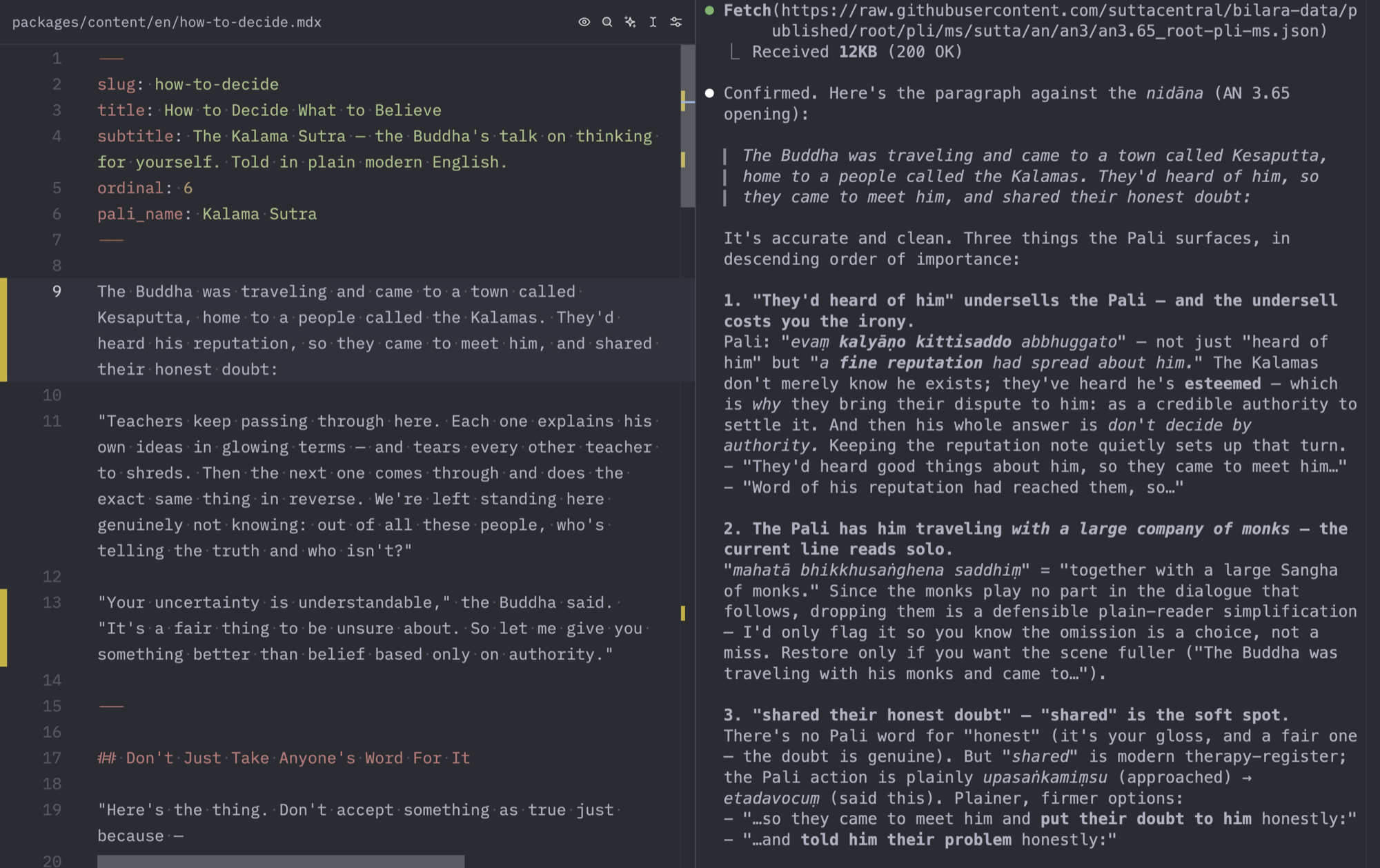
Take the monks the Buddha travels with in How to Decide What to Believe.
“The Buddha was traveling with many monks and came to a town called Kesaputta… They’d heard good things about him, so they came to meet him, and told him their doubt directly.”
We talked about a sangha of bhikkhus. We tried on many followers. We came back to looking for both — what readers would understand, and what was still true to the text.
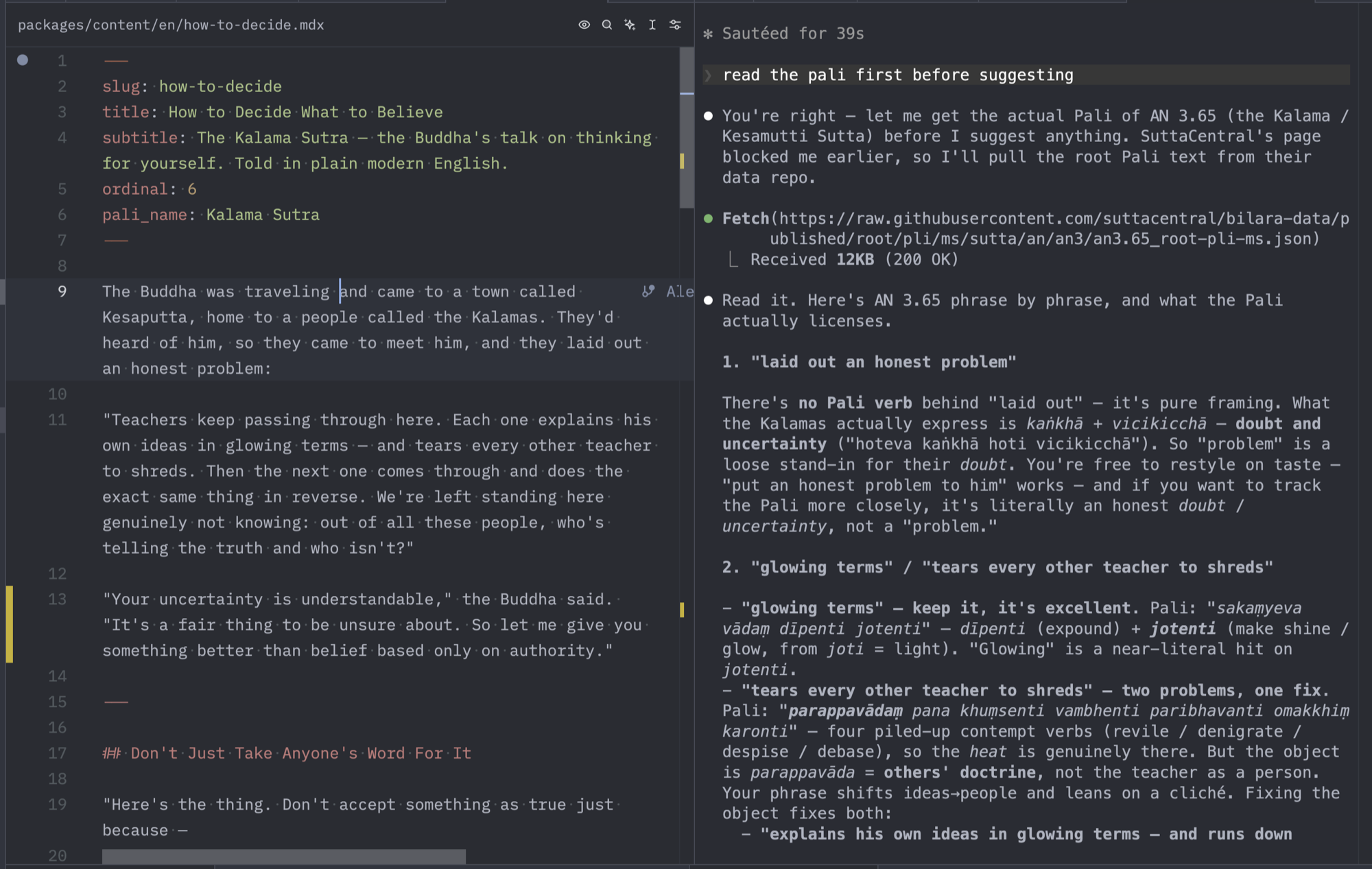
Claude framed this as a fight in this article's first draft, but it isn’t — there was no adversary. Or the only adversary was the AI’s agreeableness: Claude told me I was right no matter how I put it. So the real work was against that.
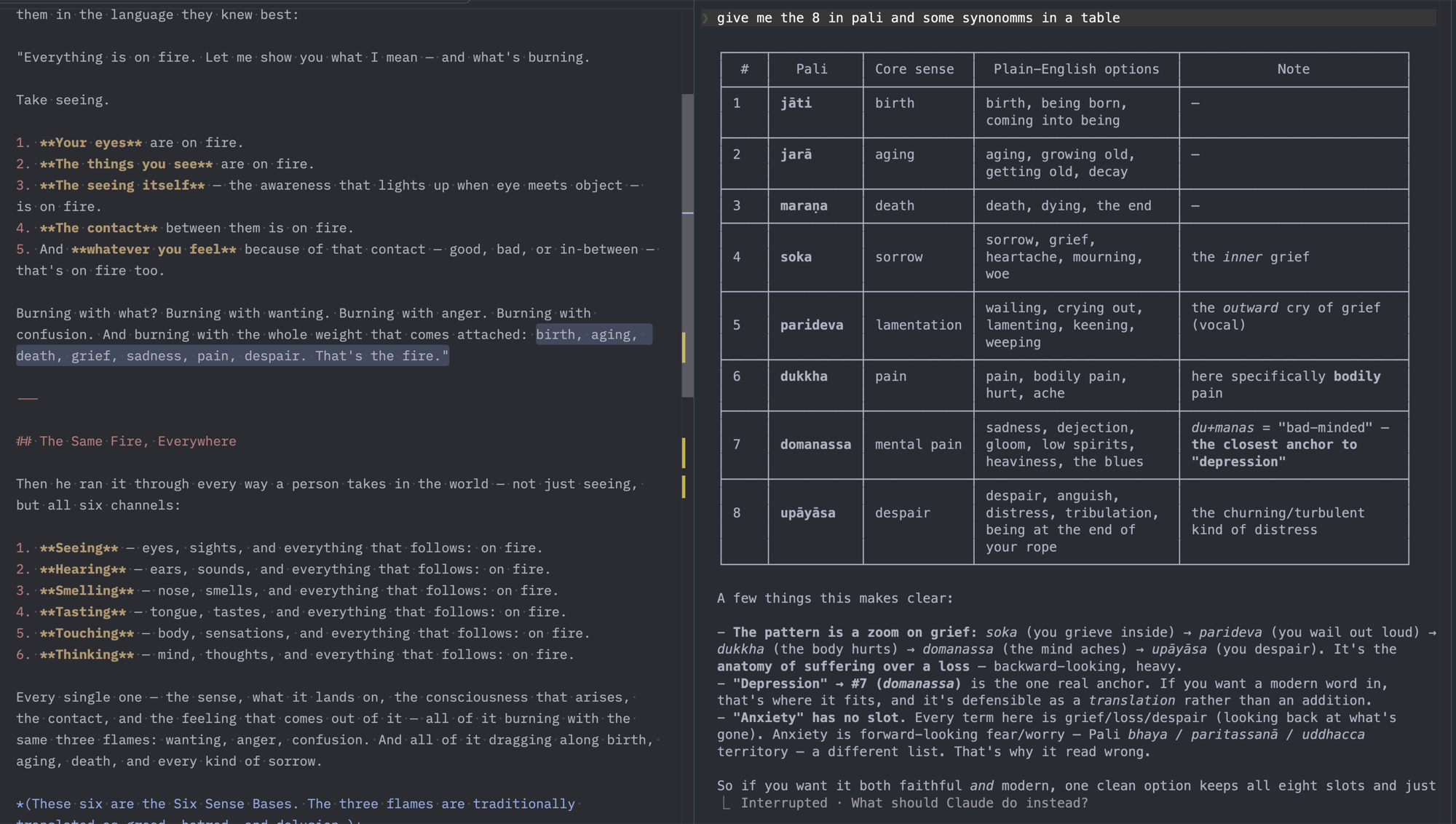
You can’t trust “it felt right” when the machine agrees with everything; you have to keep demanding the ground under the answer — fetch the Pāli, lay every term and its meanings out in a table — so you’re choosing from the real range, not from flattery.
For example, the three poisons — moha, rāga, dosa — are Englished by tradition as delusion, greed, and hatred; I kept asking until I got to “confusion, wanting, anger”. Plain words we all feel. Ours stayed — and because the canonical words are repeated so often, we wanted to show them too, beside ours.
The whole thing was done in a week. Most of the finishing happened on a flight from Chiang Mai to Surabaya — pen on a printed proof, reading along with the audiobook word for word, catching a pop in the audio, nudging the pacing.
Living with the Text
Then I looked up. A woman in the row ahead was reading the first sutta — twenty stark Latin letters, Dhammacakkappavattana, in a sea of Chinese characters. Taken by the coincidence, I started a conversation. She had just finished a 25-day vipassanā retreat, and she was generous with it: her teacher was wonderful, room 12b at such-and-such monastery, there between nine and ten each morning, here is his number — and a book. The book was the constant noting.
She was kind, and I wished her well. And then — editing, that very hour, the sutra that says to love every living thing as a mother loves her only child — I caught myself. Did I? I’d wished her well and judged her in the same breath. The teaching was already working on me, and I was already failing it.
And I did read the book she gave me — the next six hours, flight and layover and flight again. I tried the techniques, the mental repeating of words: left foot rising, left foot falling, right foot rising, right foot falling, breathing, breathing, breathing, breathing.
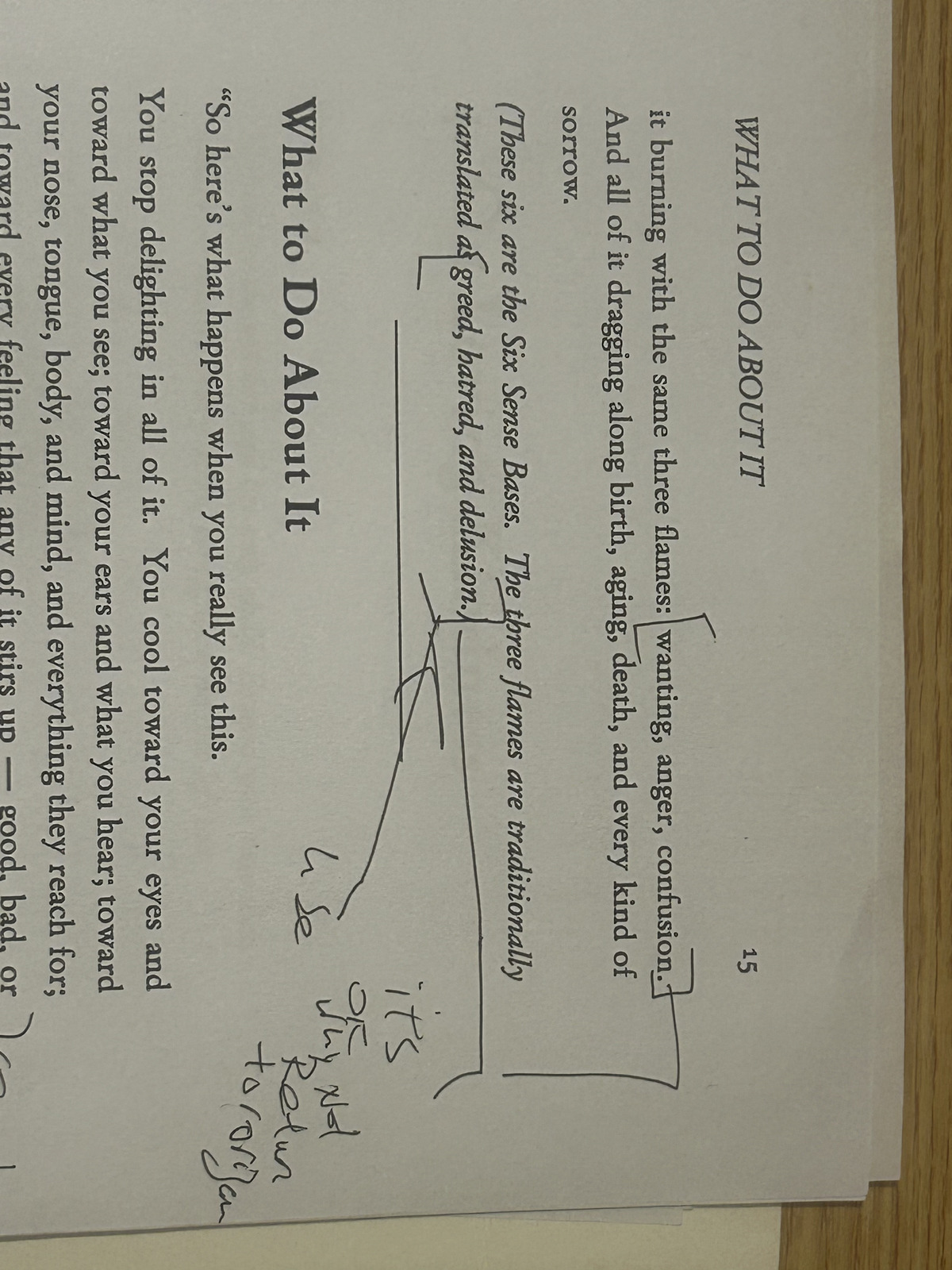
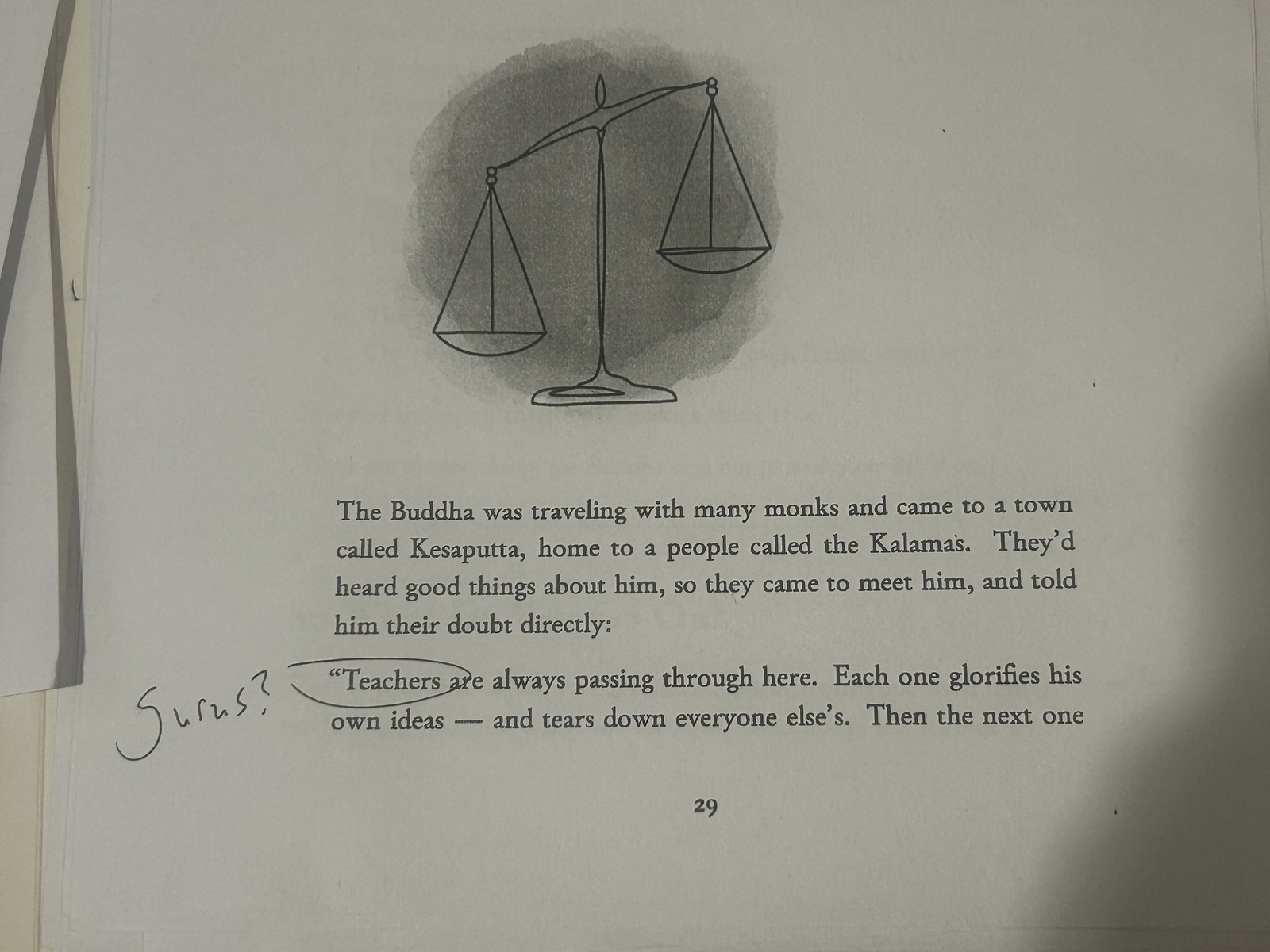
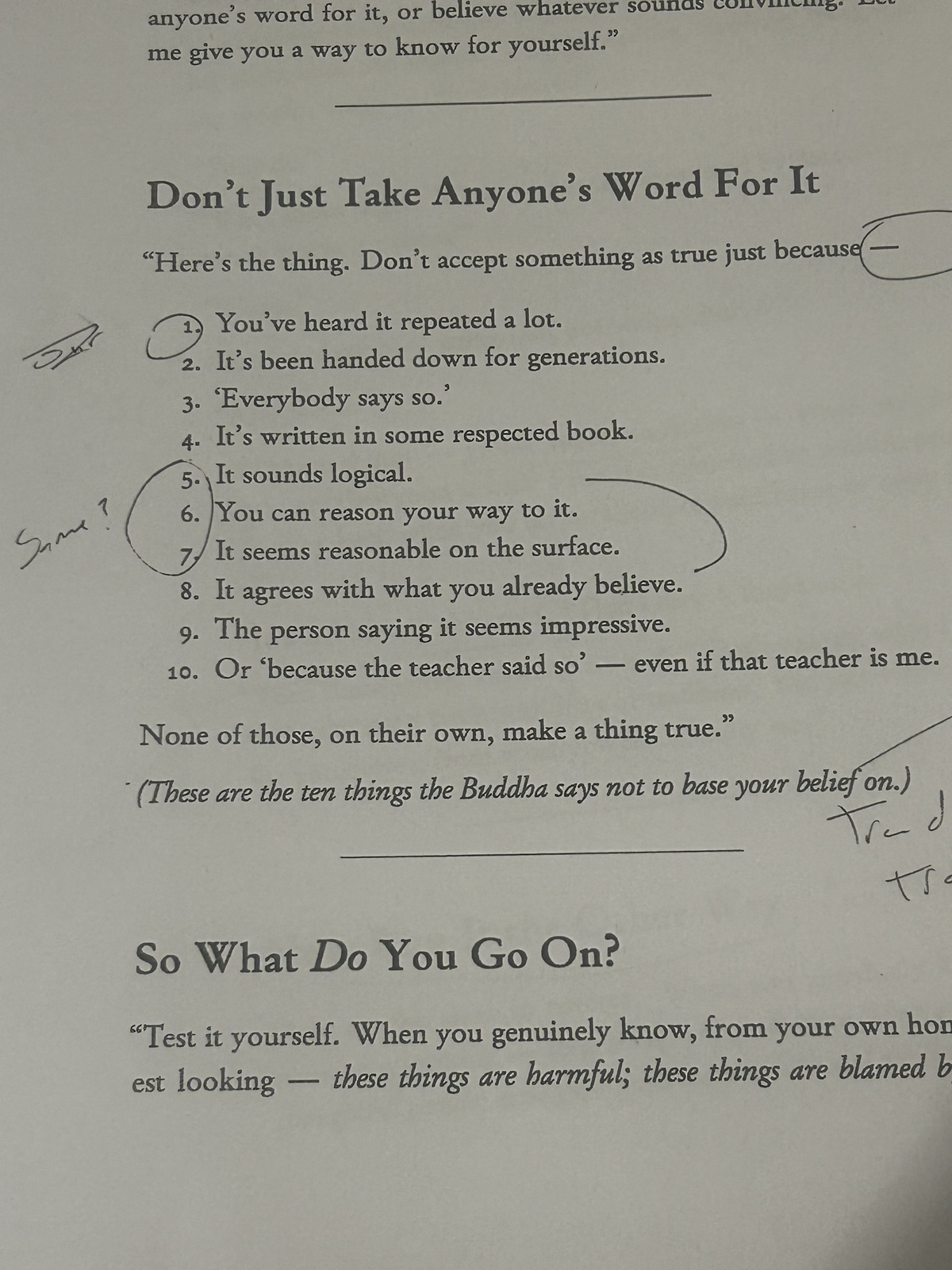
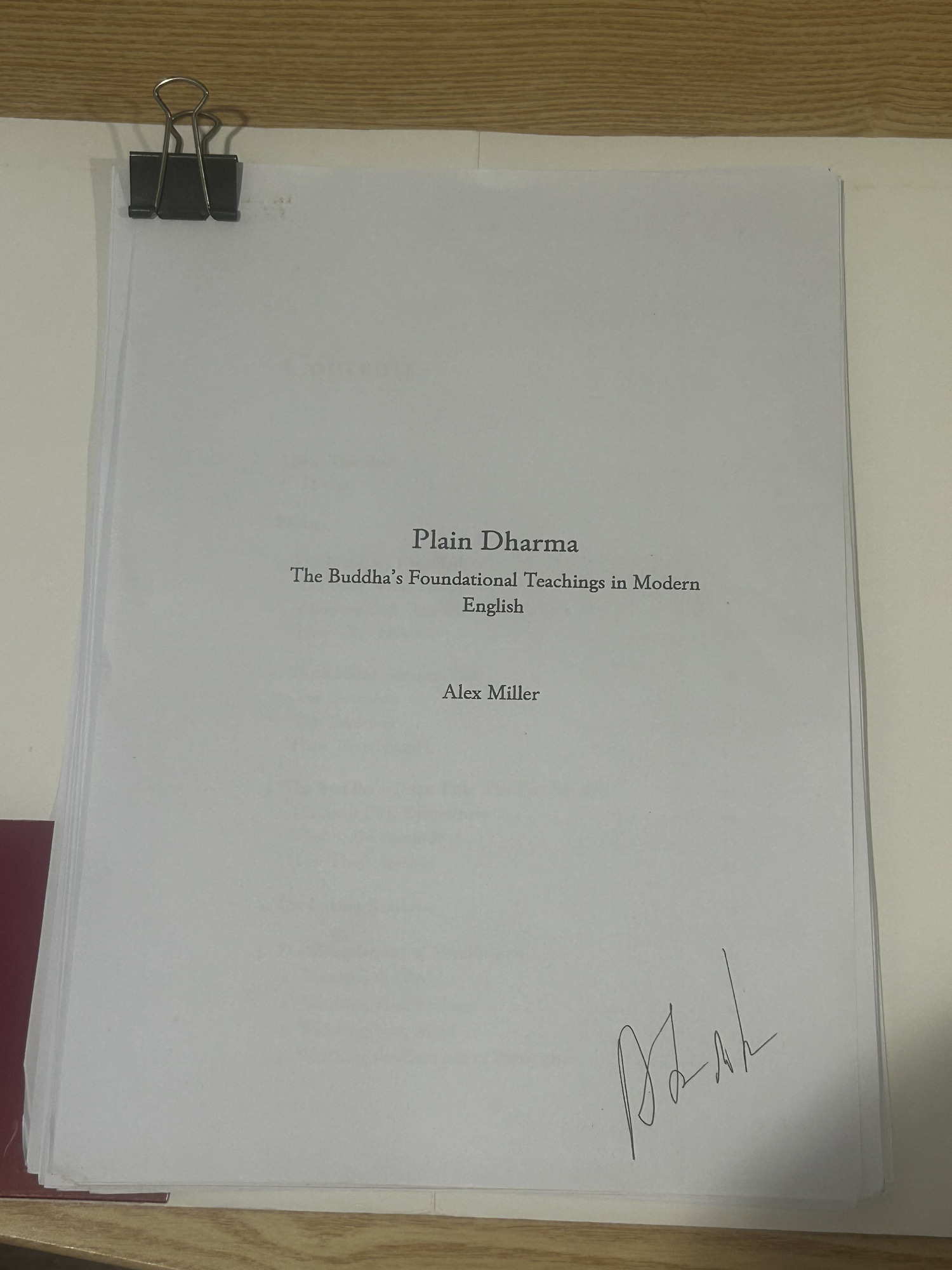
The proof, hand-marked over the Andaman Sea. Fittingly, the most marked-up page is the Kālāma Sutta — the one teaching that says test it yourself, don’t take anyone’s word for it.
More Than the Words

The audiobook was its own long labor. I auditioned dozens of voices — thirty thousand ElevenLabs credits, burned just trying them on different passages. The one I kept — a voice called Theo Silk — I had to fight: it misreads emotion, runs a little fast, a little slow.
I prompted it flat and calm and slow, then dragged it 20–30% slower still — cut, stitched, re-rendered and stitched back in, 700 milliseconds of silence dropped between sections to let them breathe — and finally re-recorded the whole thing through the API and joined it to a cover, a back cover, and a barcode. Claude designed those; my mom, a designer, fixed them — and donated the ISBN, too.
Even after all the wrestling, the ElevenLabs voice isn’t flawless — but in the end it’s meditative, and for the most part a lovely voicing, if you ask me. You can listen to it awake, or you can let it read you to sleep.
And what it reads may be the most remarkable thing here. The Metta Sutta — the discourse on loving-kindness — is, in effect, a guided meditation: the Buddha leading you, line by line, into wishing every living thing well, the way a mother loves her only child. Twenty-six centuries before Headspace, here is the practice itself, in his own words — and as far as I can tell, the first guided meditation, by the Buddha himself.
Click to listen to the Metta Sutra in its entirety — a guided meditation by the Buddha himself.
The Mobile App
The mobile app was a labor of love too: an audio player with offline downloads, a free CC0 copy to keep, and a donate page (a man’s got to eat; here’s my bowl). And all of it runs in three scripts — English, and Chinese in both Simplified and Traditional — though the Chinese is still as the machine rendered it. A friend has promised to edit it one day; until then, the contributors page is wide open.
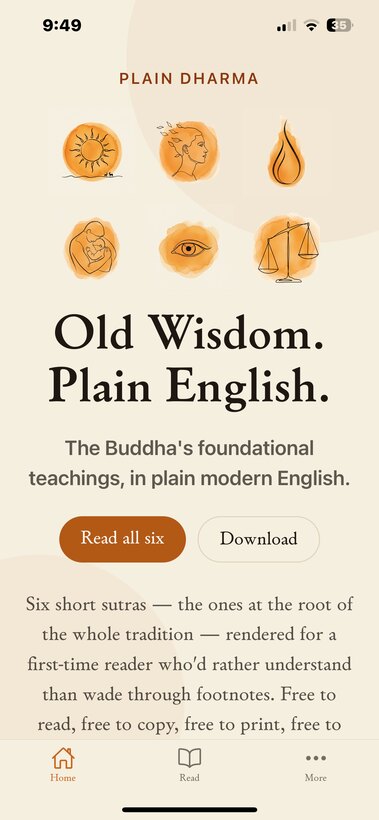
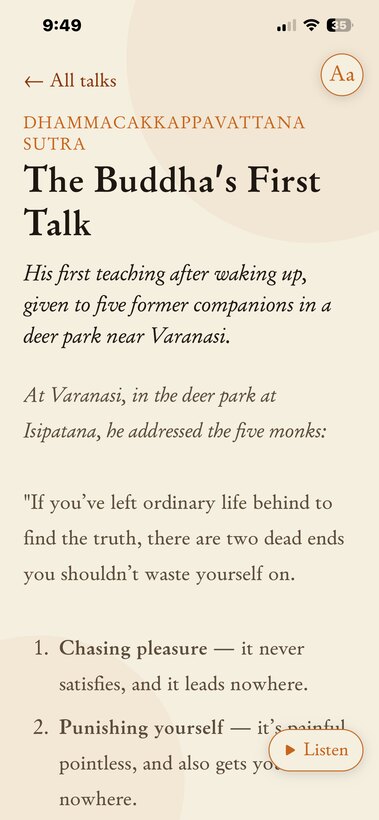
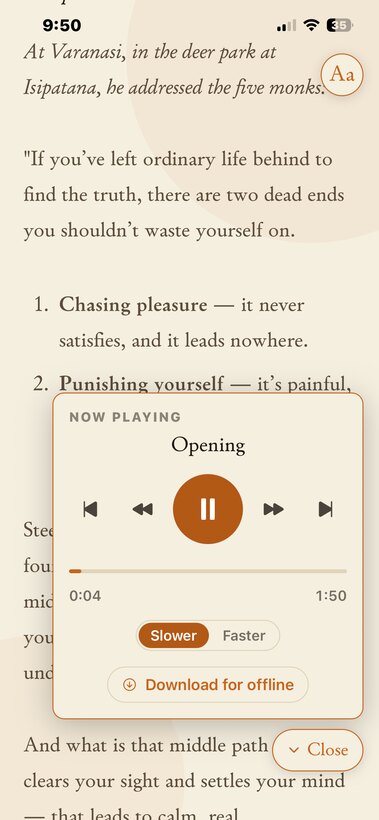
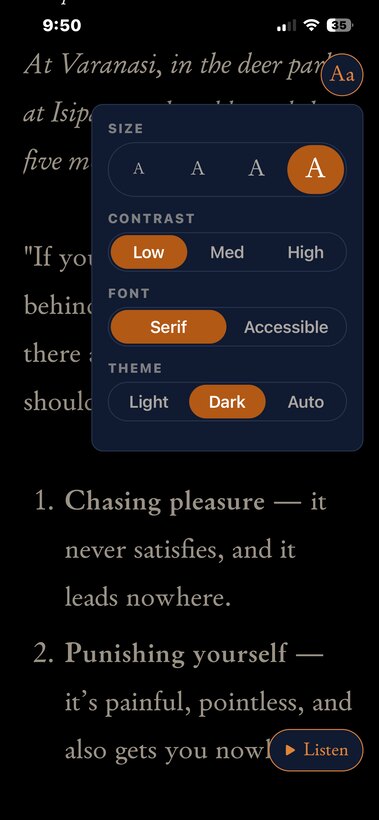
The app: read, listen, adjust, take it offline — light or dark.
Receipts
None of this asks you to take my word for it either. There are two trails. The revision history is public on GitHub — every Pāli-faithfulness pass is a commit you can open and read. And the human finishing is here: the working sessions and the marked-up proof. The diffs prove the work was real; the manuscript proves it was cared for.
The translation was first drafted from the Pāli with the help of Claude; the illustrations began with Gemini; the first narration with ElevenLabs. Almost none of it was left as the machine made it — the Chinese still is, for now. And all of it is released into the public domain under CC0 — copy it, print it, translate it, make it more human. That part’s up to you now.
So Now What?
Just sit and listen to six short sutras. We think you will greatly enjoy them.
Turn them over in your mind. Sleep on them, wake on them, and fully get them.
Or let them be a jumping-off point, to further reading, further meditations and further understanding. Or give some new translations a go yourself. I’m happy to publish more on-topic work.

One Last Coincidence
All of this was written over Eid al-Adha, the Festival of Sacrifice — the story of Abraham, the one that parts Isaac from Ishmael. Jews and Christians trace themselves to one son, Muslims to the other, and each has made the story about itself. That is how it divides us. To me it should mean the opposite: that we are all brothers — and that we might love one another the way a mother loves her only child. Not the way Abraham loved his.
Though maybe that’s unfair to Abraham. Maybe God makes it hard for us on purpose — so we can taste how sweet the good parts are.