

Anattā
Pali; Sanskrit: anātman.


"Not-self." The teaching that no permanent, separate self can be found in any aspect of experience.
Where it appears
4 passages in 3 of the six teachings.
The Buddha's First Talk
Chasing pleasure — it never satisfies, and it leads nowhere. And punishing yourself — it's painful, pointless, and also gets you nowhere.
… kāmasukhallikānuyogo hīno gammo pothujjaniko anariyo anatthasaṁhito, yo cāyaṁ attakilamathānuyogo dukkho anariyo anatthasaṁhito.
See it beside the Pāli →
The Buddha's Second Talk
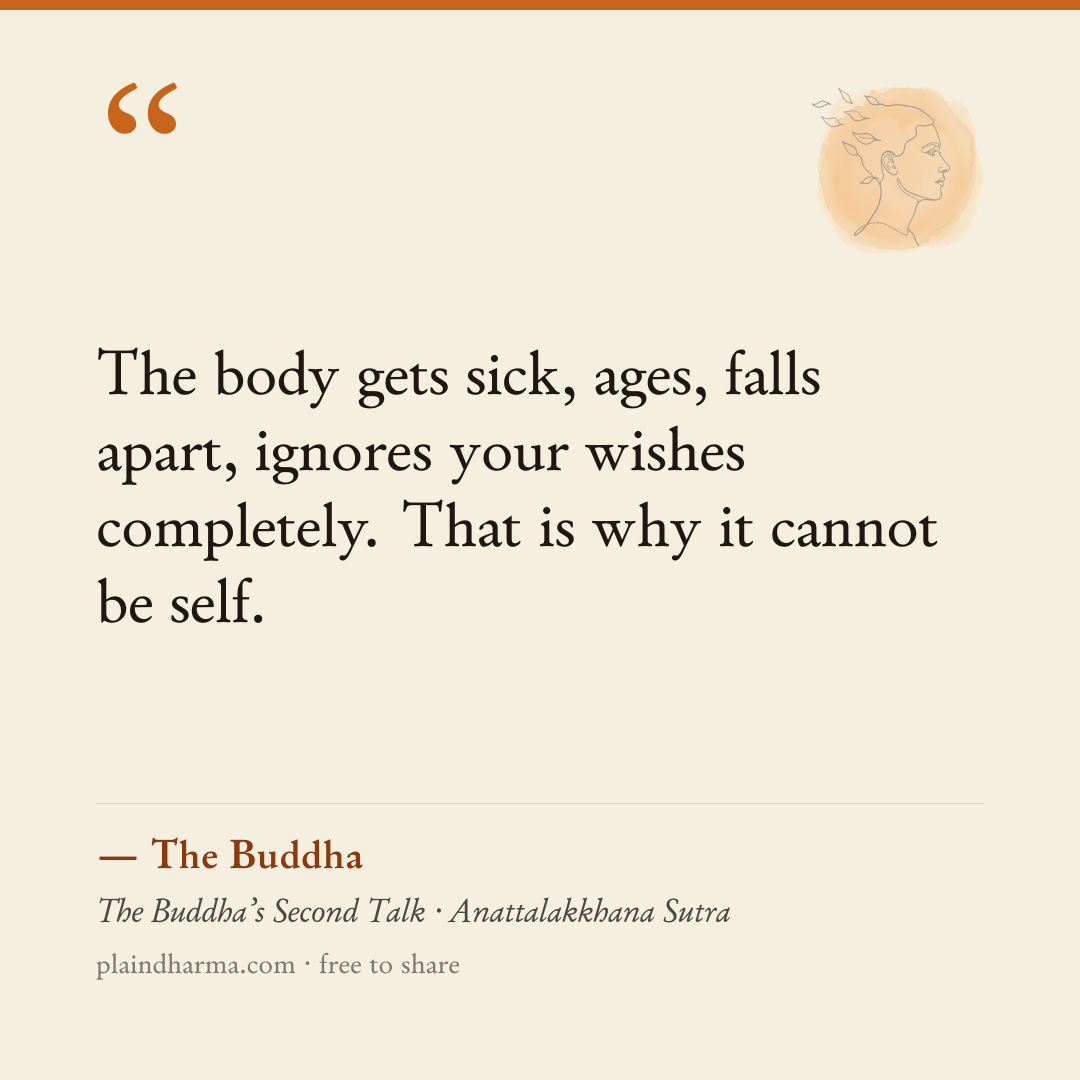
Here's something to look at closely. The body isn't you. If the body really were you — your self, the thing you actually are — then it would never let you down, and you'd be able to tell it: 'Be like this, don't be like that,' and it would…
“Rūpaṁ, bhikkhave, anattā. Rūpañca hidaṁ, bhikkhave, attā abhavissa, nayidaṁ …
See it beside the Pāli →And the same goes for the rest of what you take yourself to be: the body isn't you; your feelings — pleasant, unpleasant, neutral — aren't you; your perceptions — the way you recognize and label things — aren't you; your impulses — the…
Vedanā anattā. Vedanā ca hidaṁ, bhikkhave, attā abhavissa, …
See it beside the Pāli →
The Foundations of Mindfulness
(These are the same five from the Not-Self talk.
See it beside the Pāli →
In Chinese: 无我